
You’re about to book a tire appointment, or you’re wondering whether the all-seasons currently on your car are actually going to cut it once the snow starts falling, and the honest answer depends heavily on which province you’re in. Winter tire rules in Canada aren’t one national law - they’re a patchwork, with two provinces enforcing hard requirements and the rest leaving the decision to you. Here’s what actually applies where you drive.
Quebec: Mandatory, Province-Wide
Quebec has the strictest rule in the country. Winter tires are legally required on passenger vehicles from December 1 to March 15 every year, full stop, across the province - not just on certain highways. This is the one province where “recommended” isn’t the operative word; it’s the law, and it applies broadly to vehicles registered and driven in Quebec during that window.
British Columbia: Mandatory on Signed Highway Routes
BC’s rule is narrower but still legally binding. Winter tires (or chains) are required on designated highways - largely mountain passes and rural routes prone to snow and ice - from October 1 to April 30. These routes are marked with signage, so the requirement is location-specific rather than covering every road in the province the way Quebec’s law does. If you’re driving through BC’s interior or mountain highways in that window, check for the posted signs; if you’re sticking to Lower Mainland city streets, the mandatory window may not apply to your specific route, though winter tires are still a good idea given BC’s wet, occasionally icy winter conditions.
Everywhere Else: Recommended, Not Mandatory
Outside Quebec and BC’s signed routes, no province currently makes winter tires a legal requirement. That doesn’t mean they’re optional in any practical sense - it just means the law isn’t the thing pushing you toward them. Provinces like Ontario, Alberta, Manitoba, Saskatchewan, and the Atlantic provinces all see real winter driving conditions, and winter tires remain the single best equipment upgrade for cold-weather grip regardless of what the law says.
Some insurers offer a discount for having winter tires installed, since better traction correlates with fewer claims - ask your specific insurer whether they offer one and what documentation they need (a receipt or shop invoice showing the tires are on the vehicle is common). Don’t assume a discount applies automatically; confirm it directly rather than guessing at an amount.
Quick Reference by Province
| Province | Rule | Window |
|---|---|---|
| Quebec | Mandatory, province-wide | Dec 1 – Mar 15 |
| British Columbia | Mandatory on signed highway routes | Oct 1 – Apr 30 |
| Ontario | Recommended, not mandatory | Winter season |
| Alberta | Recommended, not mandatory | Winter season |
| Manitoba | Recommended, not mandatory | Winter season |
| Saskatchewan | Recommended, not mandatory | Winter season |
| Atlantic provinces | Recommended, not mandatory | Winter season |
Always check current provincial and municipal rules before a trip, especially if you’re driving through more than one province or into a signed BC mountain route - requirements and signage are set locally and can shift.
Mountain Symbol vs. M+S: What’s the Difference?
Not all tires marketed as “winter-capable” perform the same, and the two symbols on a tire’s sidewall mean genuinely different things:
The mountain/snowflake symbol (a three-peak mountain with a snowflake inside) means the tire has been tested and meets a specific performance standard for snow traction. This is the mark to look for on a true winter tire - it’s a performance certification, not just a label.
M+S (Mud + Snow) appears on many all-season tires and indicates a tread pattern designed to handle mud and light snow better than a pure summer tire. It is not the same certification as the mountain symbol and does not guarantee the same cold-weather grip or ice performance. A tire can carry M+S markings without coming close to true winter-tire performance in freezing temperatures.
If a province’s rule (like BC’s or Quebec’s) specifies “winter tires,” it’s generally the mountain symbol that satisfies the requirement - an M+S all-season alone typically doesn’t meet that bar on the routes where it’s enforced. Check the specific wording of the rule you’re driving under if you’re unsure which tires qualify.
When All-Seasons Genuinely Fail
All-season tires are a compromise by design, and the compromise breaks down in a specific, predictable way: rubber compounds in all-season tires stiffen once temperatures drop below roughly 7°C, losing grip even on dry pavement, well before you hit snow or ice. Winter tires use a softer compound engineered to stay flexible in the cold, which is why the performance gap between the two widens sharply once temperatures fall - it’s not just about snow on the ground, it’s about cold rubber losing traction on any surface.
Practically, this means the moment all-seasons tend to fail you isn’t always the dramatic snowstorm - it’s often the ordinary cold, dry morning where braking distance quietly gets longer than you’d expect, or the black ice patch on a bridge deck that a winter tire’s compound and tread would have handled better. If you regularly drive in temperatures that stay below freezing for weeks at a time, that’s the strongest practical case for winter tires regardless of what your province’s law technically requires.
What to Do If You Get Stuck Anyway
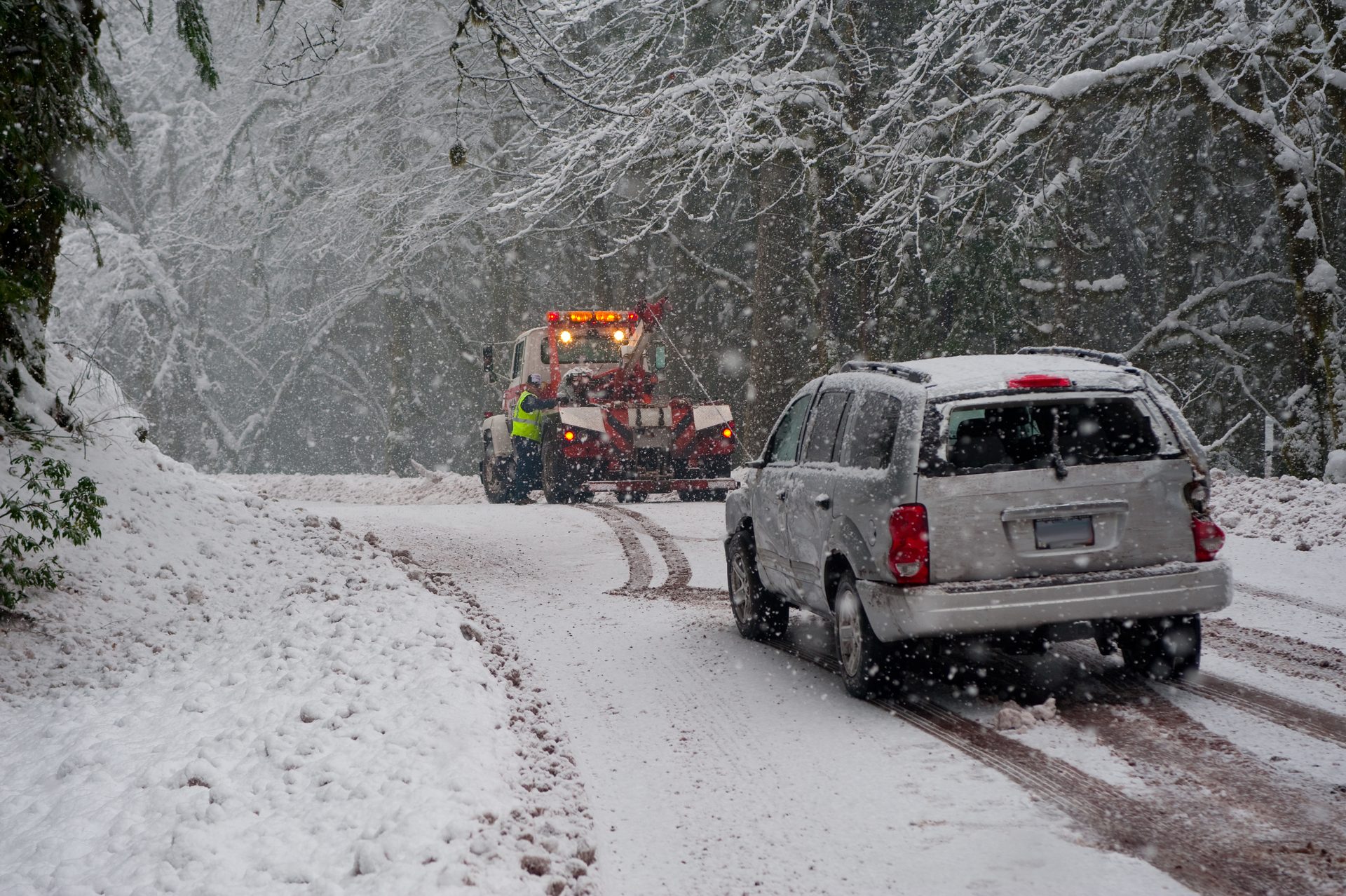
Even with the right tires, winter conditions can still put you in a ditch or stranded roadside. If that happens, know that winching is typically billed separately from a standard tow, and a flatbed tow is often the right call for AWD vehicles or anything with driveline damage from spinning wheels in snow. Keep hazards on, stay visible, and find a tow truck near you rather than attempting a risky self-recovery on an active road.
FAQ
Which provinces legally require winter tires? Quebec requires them province-wide from December 1 to March 15. British Columbia requires them (or chains) on designated, signed highway routes from October 1 to April 30. Other provinces recommend but don’t mandate them.
Is M+S the same as a winter tire? No. M+S indicates a tread designed for mud and light snow, common on all-season tires, while the mountain/snowflake symbol certifies genuine winter performance. Only the mountain symbol reliably meets the standard that provincial winter tire rules are generally referring to.
Do I get an insurance discount for winter tires? Some insurers offer one, since better traction is linked to fewer claims, but it’s not universal or automatic. Ask your specific insurer what they offer and what proof they require.
Can I drive on all-seasons through a Quebec or BC winter if I’m just passing through? No - if you’re driving in Quebec during its mandatory window or on a signed BC highway route during its window, the requirement applies to your vehicle regardless of where you’re registered or headed. Check the rule before you cross into that province.
At what temperature do all-season tires stop performing well? Their rubber compound starts stiffening and losing grip at around 7°C, even on dry roads - well before snow or ice enters the picture. That’s the practical threshold worth remembering when deciding when to switch.
Getting stuck or stranded despite good tires still happens. Find a tow truck near you or check the towing cost calculator for a rough sense of what a winter recovery might run.